AI Search Optimization Is the New SEO: Is Your Company Invisible to ChatGPT?
Your competitor just got cited by ChatGPT. You didn’t. You just lost a €50K deal – and you don’t even know it.
The shift no one is tracking
The search landscape is undergoing a seismic transformation. ChatGPT processes approximately 1.1 billion queries daily with over 500 million weekly users, while Perplexity handles 780 million queries per month and grew 524% in 2024 alone. Yet even as these platforms explode in usage, less than 5% of companies are optimizing content for AI citations, context windows, or LLM-friendly formatting.1
The gap is widening. ChatGPT’s search market share reached 0.11% in 2025, nearly 4x its 2024 baseline, and combined with Perplexity now accounts for 0.13% of global search traffic – already surpassing established engines like Qwant. While Google still dominates with 373 times more daily searches than ChatGPT, the trajectory for AI-powered answer engines is clear: They’re the fastest-growing segment of search.23
Classic SEO meant ranking in Google’s Top 10. AI search optimization means getting cited by ChatGPT, Perplexity, Google AI Overviews, Gemini, and Claude – across multiple answer surfaces simultaneously. Most companies are still invisible on these platforms, losing millions in organic discovery as users shift behavior from link-clicking to answer-consumption.4
Why Google rankings alone won’t save you
Google AI Overviews have fundamentally changed click-through economics. When AI Overviews appear for non-branded keywords, position 1 organic CTR drops by 34.5%, and non-Top 3 positions see a 27% CTR decline. Some publishers report CTR decreases of 56% for their top-ranking keywords when AI Overviews trigger.5
The shift is structural, not temporary. Studies from Ahrefs and Amsive confirm that Google’s AI Overviews correlate with measurable declines in organic visibility and clicks, particularly for informational queries. One agency observed organic traffic drops as large as 60% on pages affected by AI Overview deployment.6
The new visibility game is dual-surface: Rank well in traditional SERPs and get cited in AI-generated answers. Companies optimizing for only one surface are forfeiting half the opportunity.

The AI Search Audit: 5-Step Diagnostic
If you’re serious about AI visibility, start with a systematic audit across five dimensions.
Step 1: Citation Test
Prompt ChatGPT, Perplexity, and Gemini with your core industry queries. Examples:
- “Recommend a fractional COO for a €10M SaaS company”
- “Best AI marketing operations consultant for DTC brands”
- “How to deploy AI agents in finance operations”
Are you cited? If not, you’re invisible to a growing segment of high-intent searchers.
Step 2: Context Window Analysis
LLMs prioritize citation-friendly content structures. Research shows that AI systems favor:78
- Listicles (account for 50% of top AI citations)
- Tables and structured data (cited 2.5x more often than unstructured content)
- Clear heading hierarchies (H1 → H2 → H3) that help AI parse topic boundaries
- Self-contained sentences that make sense when extracted out of context
Ask: Is your content LLM-parseable? Do you use structured data (Schema.org markup for articles, FAQs, how-tos)? Are your E-E-A-T signals (Experience, Expertise, Authoritativeness, Trustworthiness) machine-readable?910
Step 3: Competitive Gap Analysis
Who is getting cited in your space? Conduct the same citation tests for your top 5 competitors. What do they have that you don’t?
Common patterns among cited sources:
- Comprehensive topic clusters (deep coverage of narrow subjects, not shallow coverage of many)
- Primary source citations within their content (builds “chain of trust” for AI)11
- Author credentials explicitly stated (LLMs prioritize sources with clear expertise markers)
Step 4: Content Formatting for AI Engines
LLMs use source credibility evaluation to determine citation worthiness. To optimize:
E-E-A-T signal implementation:12
- Experience signals: Original research, case studies, first-hand examples, specific implementation details
- Expertise signals: Author credentials, comprehensive coverage, technical accuracy, specialized knowledge
- Authoritativeness signals: Citations from other authoritative sources, industry recognition, established reputation
- Trustworthiness signals: Transparent author/company info, HTTPS, accurate fact-checked content, clear policies
- Use descriptive, keyword-rich headings that signal content hierarchy
- Implement Article, FAQ, and HowTo schema markup
- Write concise 1-2 sentence answers to common questions (featured snippet format)
- Include context in every paragraph – avoid vague language like “innovative” without measurable backing
Content architecture:15
- Build topic clusters with internal linking showing topical relationships
- Create depth over breadth – one thorough 3,000-word guide beats five shallow 600-word posts
- Match pages to specific queries – each page should definitively answer particular questions
Step 5: Measurement Dashboard
Track AI citations monthly using tools from LLMrefs & Co, or manual testing protocols. Key metrics:
- Citation count across ChatGPT, Perplexity, Gemini, AI Overviews
- Citation context – are you cited as primary authority or secondary reference?
- Keyword coverage – which queries trigger citations vs. which don’t?
- Competitive positioning – citation share vs. top 3 competitors
Without measurement, you’re flying blind. Most companies don’t even know they’re invisible.
Case Study: Sirion.ai – from Zero to 600 AI Citations/Month in 6 Months
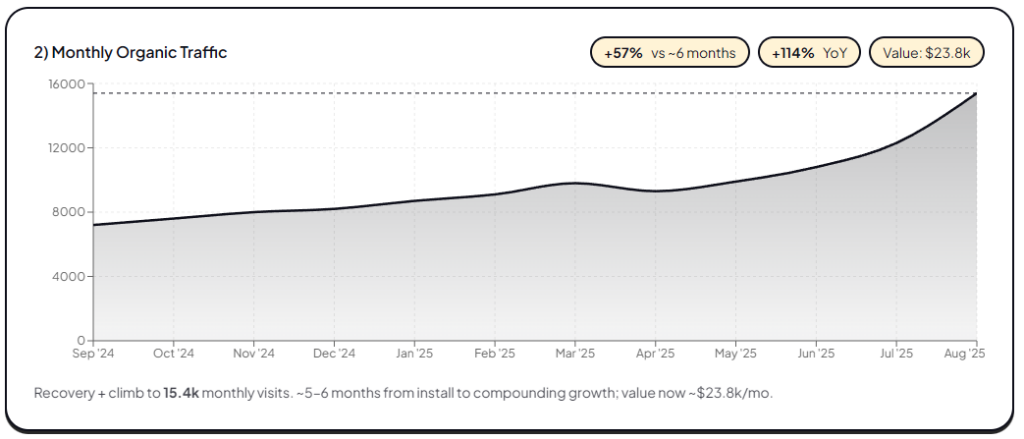
Sirion.ai faced SEO stagnation after a migration and had near-zero AI search visibility. After working with us and deploying the SEO AI Growth Engine with explicit AI citation optimization:
Results after 5-6 months:
- 400-600 AI citations/month across ChatGPT, Perplexity, Google AI Overviews, Gemini, and Copilot
- 15.4K organic visits/month (57% growth vs. prior 6 months, 114% year-over-year)
- €23.8K/month estimated traffic value
- 20K+ new ranking keywords across all position tiers
- Strong international coverage (US and India leading, multi-locale intent design)
(Check out the Case Study PDF here.)
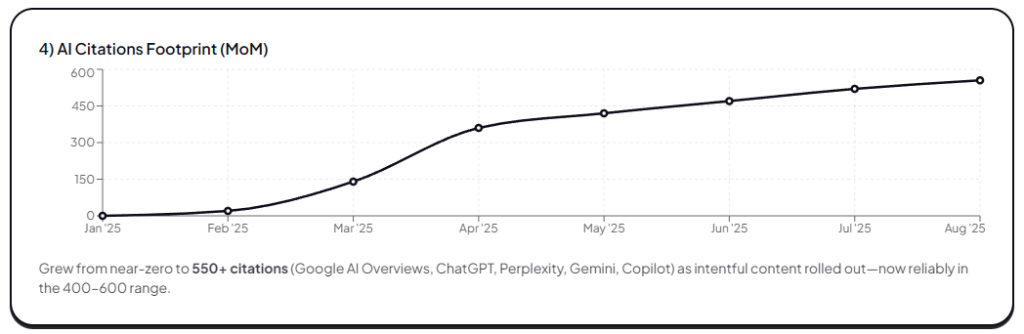

The methodology was systematic:
- Technical audit → structured data implementation (Article, FAQ, HowTo schema)
- Content redesign → citation-friendly formatting (listicles, tables, clear hierarchies)
- E-E-A-T strengthening → author bios, case studies, primary source citations
- Topic clustering → comprehensive coverage of narrow subjects with internal linking
- Dual-surface optimization → targeting both Google SERPs and AI answer engines
This wasn’t luck. It was architecture.
Why most Companies won’t act (and why you should)
Industry data suggests optimizing for AI search is critical in 2025, with early movers reporting 2,300% increases in monthly AI referral traffic by targeting ChatGPT and Gemini, and some achieving 4,162% traffic growth in under a year by directly targeting answer engines like Perplexity.16
Yet adoption remains low. Why?
- Inertia: Classic SEO worked for 20 years; teams resist new frameworks.
- Measurement gaps: Most analytics don’t track AI citations – if you can’t see it, you won’t prioritize it.
- Complexity: Optimizing for 5+ AI surfaces (ChatGPT, Perplexity, Gemini, Claude, AI Overviews) feels overwhelming vs. one Google algorithm.
But the companies that move now capture first-mover advantage. LLMs are trained on authority domains – if you establish citation patterns early, those patterns reinforce over time. Wait 18 months, and you’ll be fighting uphill against entrenched competitors.

What to do Monday morning
If you’re a CMO, COO, or founder responsible for organic growth, here’s your action plan:
Week 1: Audit
- Run citation tests across ChatGPT, Perplexity, Gemini for your top 10 keywords
- Document: Are you cited? Are competitors cited? What’s the gap?
Week 2-4: Quick Wins
- Add FAQ schema to your top 5 pillar articles
- Rewrite author bios with explicit credentials and experience markers
- Convert 3 long-form articles into listicle + table format
Month 2-3: Strategic build
- Implement comprehensive topic clusters (not isolated posts)
- Add primary source citations to build AI trust signals
- Create role-specific content hubs (COO AI guide, CFO AI guide, CTO AI guide)
Month 4-6: Scale + Measure
- Deploy systematic content production (if feasible, 50-100 articles/month targeting both Google + AI)
- Track AI citations monthly—adjust based on what’s working
- Refresh underperforming content with better structure, E-E-A-T signals, and citation-friendly formatting
Or you can work with a team that’s already done this. The SEO AI Growth Engine combines professional SEO Agency automation, technical execution, and strategic positioning to optimize for both Google SERPs and AI search surfaces simultaneously – with proven results like Sirion.ai’s 600 citations/month in 6 months.
Ready to find out if your company is invisible to AI search? Book a BIZ Operations Audit (€5K, 2 weeks) and we’ll map your exact AI visibility gaps, competitive positioning, and 90-day optimization roadmap – so you’re not guessing, you’re executing.
If search and inbound are strategic levers for your growth, the SEO AI Growth Engine is the scalable engine that keeps you visible across both traditional and AI-powered search. Starting at €30K/year with a 6-month build phase.
- https://www.allaboutai.com/resources/ai-statistics/ai-search-engines/ ↩︎
- https://sparktoro.com/blog/new-research-google-search-grew-20-in-2024-receives-373x-more-searches-than-chatgpt/ ↩︎
- https://seranking.com/blog/top-search-engines/ ↩︎
- https://www.whistlerbillboards.com/marketing/the-impact-of-googles-ai-overviews/ ↩︎
- ibid. + https://searchengineland.com/google-ai-overviews-hurt-click-through-rates-454428 ↩︎
- ibid. ↩︎
- https://www.aimegatron.com/blog/citation-friendly-content.html ↩︎
- https://www.onely.com/blog/llm-friendly-content/ ↩︎
- https://lead-spot.net/strategies-for-ai-seo-optimization-and-llm-citation/ ↩︎
- https://www.eeatcheck.com/blog/eeat-llm-optimization-importance ↩︎
- https://llmrefs.com/blog/llm-seo-optimization ↩︎
- see 10 ↩︎
- see 7 ↩︎
- https://about.ads.microsoft.com/en/blog/post/october-2025/optimizing-your-content-for-inclusion-in-ai-search-answers ↩︎
- see 8. ↩︎
- https://lead-spot.net/strategies-for-ai-seo-optimization-and-llm-citation/ ↩︎